Sigma 30/1.4 (for 4/3) Review
I have had two copies of the Sigma 30mm f/1.4 lens: first for my Olympus (4/3 mount) cameras, and then two for my Nikon DSLR (both copies were identical optically; the first was replaced by Sigma during a firmware upgrade). This lens seems to have been received with a love / hate relationship for most people; those who 'get it' really like it, but there are many who, either through lens defects, improper use, etc do not like the lens.
This review was originally written with my Olympus E-620 camera in mind, but has since been updated with my Nikon D7000.
There are a few different options for lenses in this range (a fast, normal prime for crop sensor cameras). On the Nikon side the lower budget options are 35/1.8 AF-S, 35/2 AF-D, and possibly the new 28/1.8 AF-S. On Olympus, you have only a few other options: the Leica 25mm/1.4 lens (about twice the price of this one), the Olympus 25mm/2.8 pancake (very nice lens, very portable, but two stops slower), or the Sigma 24mm/1.8 (well received by many, a bit wider, but half a stop slower). I had originally tried out the Nikon 35/1.8, and found it to be decent, but a persistent focusing error under tungsten light plus poor bokeh prompted me to sell it in favour of this lens.
Build Quality and Handling
This is the first thing that you notice when you take it out of the case - this is definitely not a kit lens. The construction feels very good, the focus ring is tight with tactile 'clicks' at the near and far focus limit (even though the ring will turn past the limit, you can feel when it hits). On the D7000, the Sigma HSM focusing is fast, accurate, and silent.
Focus Accuracy
A common complain about the Sigma 30mm is that many copies seem to back- or front-focus. On my D7000 I do have a -8 AF Fine Tune value set for this lens, although I have that same value for most lenses and suspect that it is my camera which is at fault. With the fine tune value, though, the lens is dead on at all focus distances. My Olympus copy seemed to be free from this issue.
Aperture / Bokeh
This is, of course, the reason why one would buy this lens. While there are many other lenses in this range which are either cheaper, sharper, or both, there is very little in this price range which gives you a sharp f/1.4 Below I have a sample shot of my son demonstrating this.

(Taken with Nikon D7000, Sigma 30mm @ f/1.4, ISO 100, 1/30s exposure)
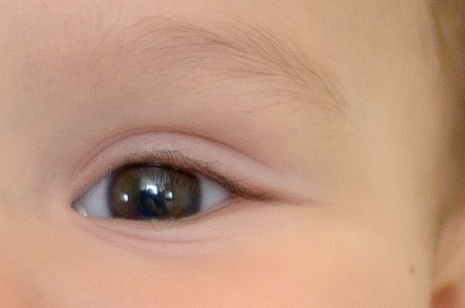
(100% crop)
To give a better idea of what the bokeh of this lens looks like, I have included three images of the same subject. All three shots were done in aperture priority on the E-620; the first was at f/1.4, the second at f/2.8, and the third at f/5.6. Note the cluttered background; the hall light and the picture frames on the wall seem to melt away with the lower apertures. The bokeh does not have many hard edges (which can at times create the 'double outline' when shooting things like sticks or other thin, contrasty objects).
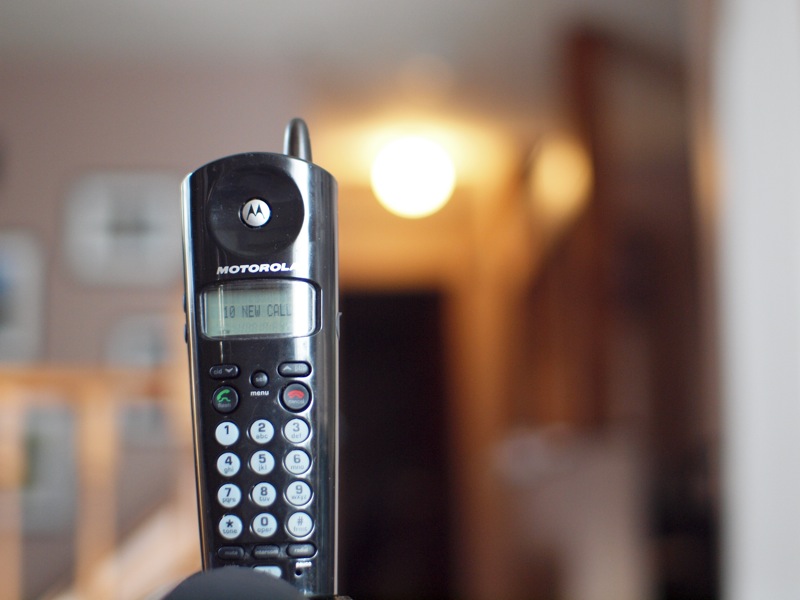
Test shot at f/1.4
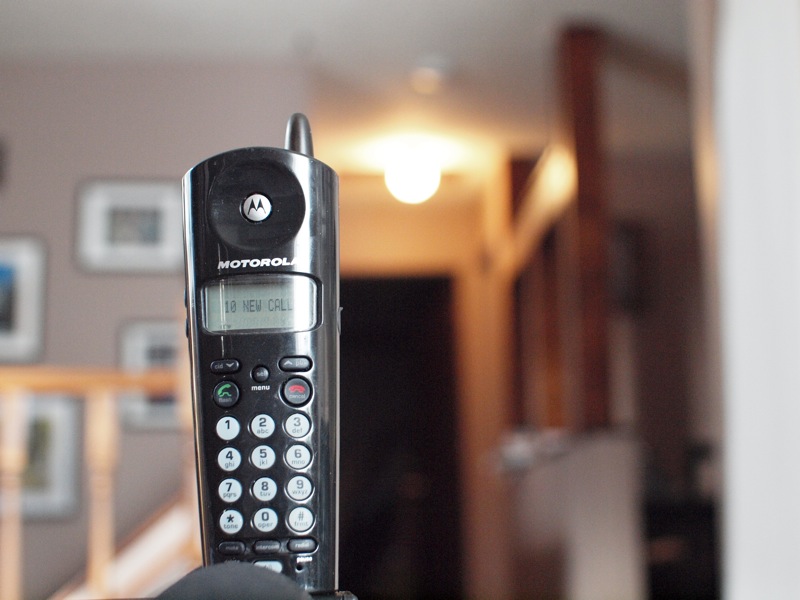
Test shot at f/2.8
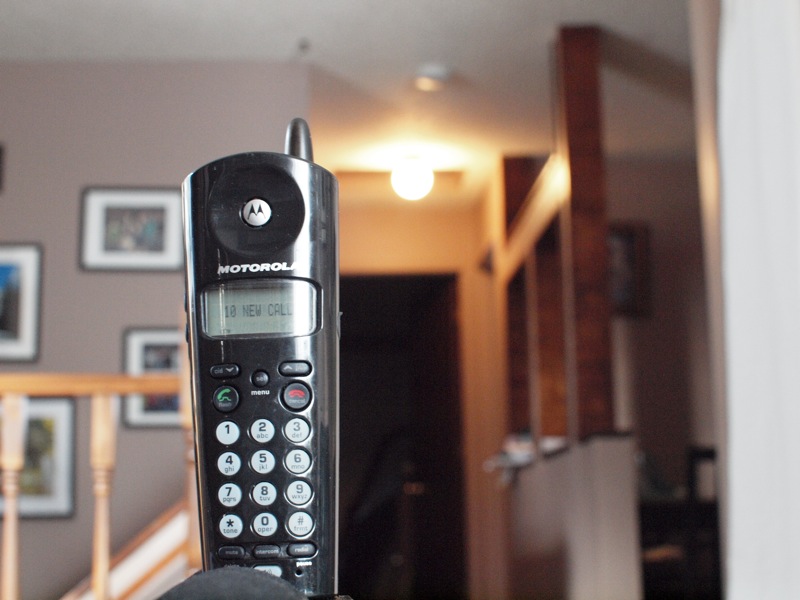
Test shot at f/5.6
One thing to note if you are used to shooting with 35mm cameras or larger DSLRs, is that the depth of field of Olympus (2x crop) cameras is abot 2 stops less than an equivalent full frame (Nikon DX is about 1 stop less DOF than full frame). This can be good or bad, depending on your shooting style. Regardless, I feel that it is important to show you about what you can expect when using this lens.
The following shot is of my daughter's homemade toy robot, named Jungle. Jungle is about 2 meters from the camera in this shot, which is approximately the distance you would be when taking a 1/2 or 1/4 length portrait.
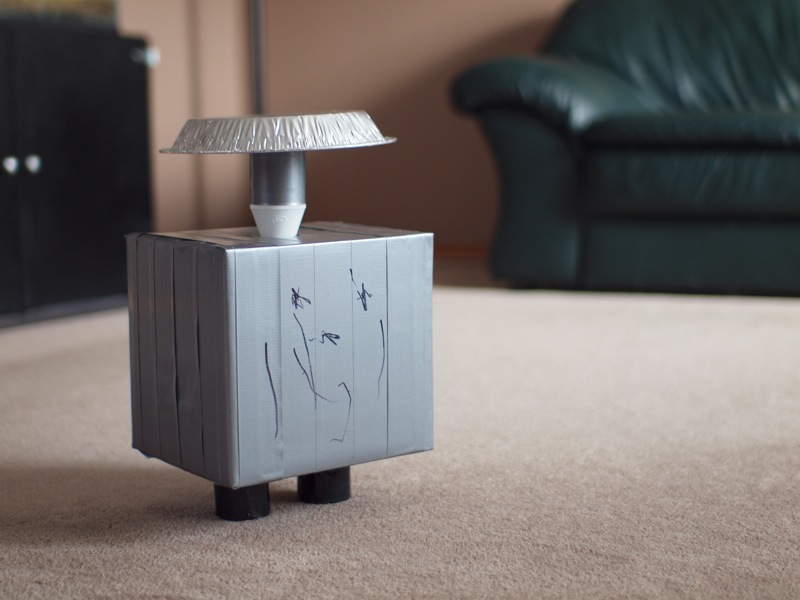
Shot at f/1.4, approximately 2 meters from the subject
As you can see, the background is relatively blurred; while you can definitely identiy objects in the background, they tend to blend together more, and lead your eye to the primary subject which is in full focus.
Color Cast
Some people complain that this lens produces pictures with a bit of a yellowish tinge; to test this, I did a comparison between this lens and the Olympus 14-42mm kit lens (at 30mm). I took two shots with a bounced flash and consistent white balance. You can see both shots below:
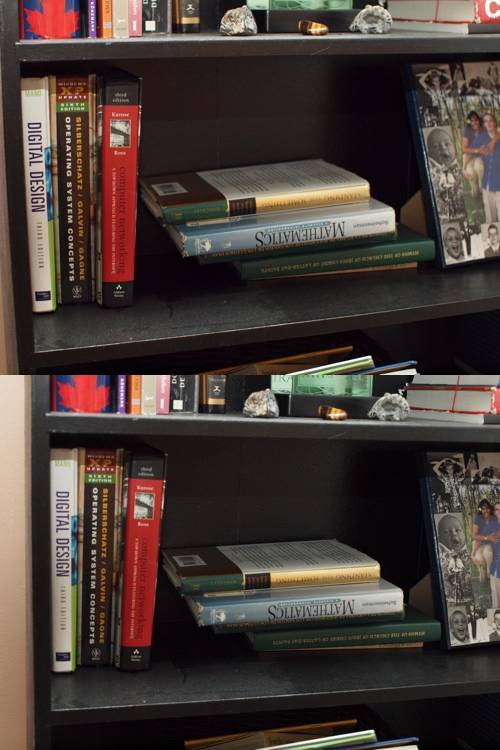
The top image was taken with the Sigma, the bottom with the Olympus. As you can see, there is a slight yellowish color cast to the Sigma lens; however, unless you have two images side by side, it is almost un-noticeable. Looking at the eyedropper values on the white 'Digital Design' book, near the top of the book, you can see the Sigma lens gives RGB of 210,207,200 while Olympus gives 207,206,202 - there may be 1% more red in the Sigma photo, but personally I don't think it is enough to worry about or even notice. Of course, if you shoot raw you always have the option of adjusting the white balance after the shoot.
Summary
In short, I feel that this lens is a great value if you are looking for one or more of the following:
- Low DOF for portraits
- Fast lens for available light shooting
- A good quality 'normal' prime lens
This lens is not for you if you want any of the following:
- Smallest / lightest lens possible (get the Pancake)
- Zoom